What Window Tint Percentage Should You Choose for Your Vehicle?
Choosing the right window tint percentage for your vehicle depends on more than appearance alone. The shade you choose can affect privacy, glare reduction, heat rejection, visibility, driving comfort, and compliance with state law. If you’ve been thinking about tinting your car but aren’t sure where to start, this guide will help you understand your options and make a more confident decision.
Check Your State Tint Laws First
Before choosing a shade, it’s important to understand your state’s tint laws. Legal tint percentages vary by state, and the rules may differ between front side windows, rear side windows, and back glass.
The legal limit for tinting your windows in the state of Kansas is 35% on the side windows and back-glass. The legal limit for tinting your windows in the state of Missouri is 35% on the front driver and passenger side windows, and there is no limit on the rear side windows and back glass.
A very popular selection amongst consumers is applying 35% on the front doors and 20% on the back-half of the car. This keeps you within the legal limit, it offers a smooth transition between the shade differences, and darker tint on the back windows provides more privacy for passengers, pets, and belongings.
Understanding Window Tint Percentage
Window tint percentage refers to Visible Light Transmission, often called VLT. This is the amount of visible light that passes through both the glass and the film. The lower the percentage, the darker the tint. The higher the percentage, the lighter the tint.
For example, a 5% tint allows only 5% of visible light to pass through, which means it blocks about 95% of visible light. A 70% tint only blocks 30% of light and makes the interior of the vehicle much brighter.
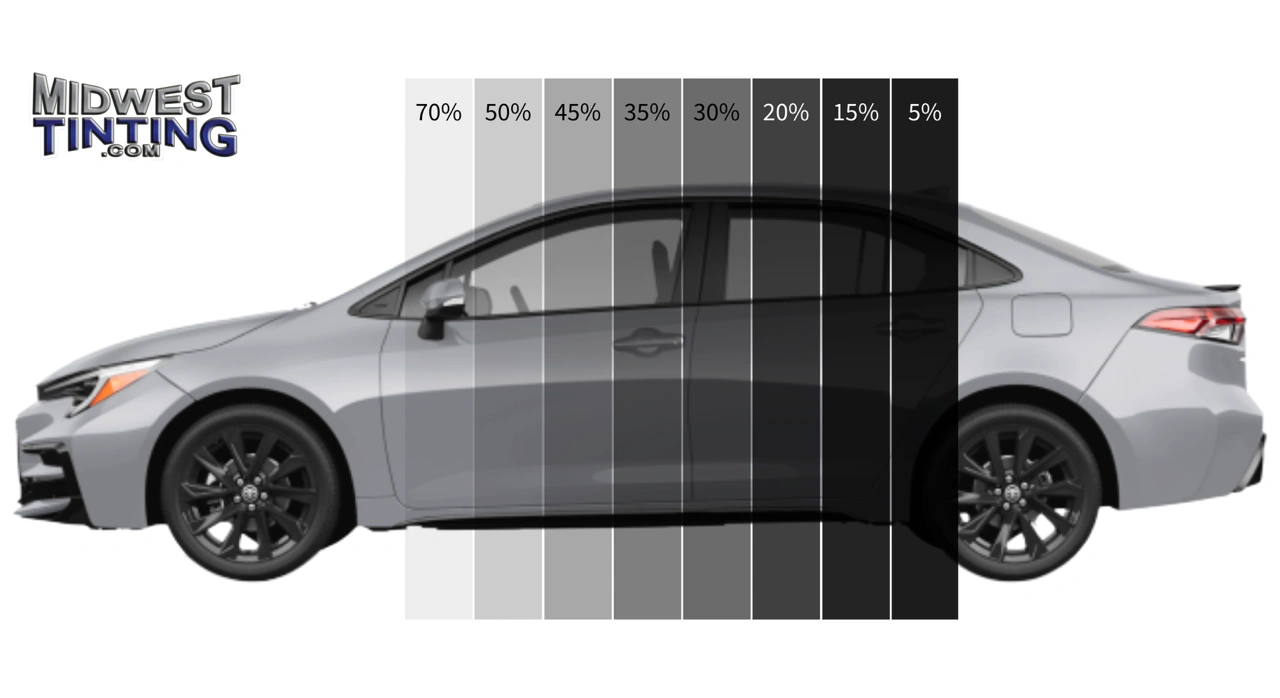
Understanding this measurement is the first step in choosing the right tint for your car, truck, or SUV. The chart below provides a guide to the different window tint percentages.
The percentage used to describe window tint refers to Visible Light Transmission (VLT). Lower percentages allow less light to pass through the glass and create a darker appearance. The guide below explains how common tint percentages look and where they are typically used.
| Tint % (VLT) | Appearance | Privacy | Common Uses |
|---|---|---|---|
| 70% | Very light. Often looks similar to clear glass. | Very Low | Windshield tint or drivers who want UV and heat protection without noticeably darkening the vehicle. |
| 50% | Light shade that slightly darkens the glass. | Low | Popular for windshield tinting or front windows when maintaining maximum visibility is important. |
| 30% – 45% | Moderate tint with a noticeable shaded appearance. | Moderate | Common choice for front side windows in many states because it balances privacy, comfort, and visibility. |
| 15% – 20% | Darker tint that significantly reduces visibility into the vehicle. | High | Often used on rear windows of trucks, SUVs, and vans to increase privacy and reduce glare. |
| 5% or Lower | Very dark “limo tint.” | Maximum | Typically installed only on rear windows for maximum privacy. Often used on work vehicles, vans, or SUVs. |
What Are You Trying to Achieve with Window Tint?
Your goals should play a major role in the percentage you choose:
- Choose a darker tint if your main priorities are privacy, glare reduction, and a darker appearance, a lower VLT may be the best fit.
- Choose a lighter tint if your main concern is UV protection and comfort, but you still want to preserve visibility and keep the glass looking relatively light, a higher VLT may be the better option.
All films available at Midwest Tinting block 99% of UV rays, which means you can still get excellent sun protection even with a lighter film. Don’t assume you must choose a very dark tint to get meaningful protection!
Vehicle Styles Affect the Appearance of Your Window Tint
Notably, the same tint percentage can look different depending on the vehicle. First, interior color matters. If your vehicle has a light interior, such as white, beige, or light gray, the tint may appear lighter from the outside. A dark interior can make the same film appear darker.
Second, vehicle height and shape can also affect the way tint looks. On sports cars or coupes that sit lower to the ground, you view the cabin at a downward angle, which can make the tint appear darker than it really is. On a truck, van, or SUV, the viewing angle is more direct at eye level, so the same percentage may appear lighter. For example: 20% tint on a sports car and 20% tint on a truck may technically be the same film, but they will not look identical once installed.
Does Your Vehicle Already Have Factory Tint?
A lot of cars, trucks and SUVs come with dyed, smoked glass on the back half, meaning the passenger rear doors, cargo area (if it has one), and back glass might already be tinted. Since the glass itself is dyed, it cannot be removed or lightened. The back is usually factory dyed to 20%, but the smoked glass offers minimal heat rejection or UV Protection benefits. Factory colored glass does not protect against harmful, cancer-causing UV Rays.
We can install film directly over the factory tint, just like normal glass. If you don’t want it to be too dark, we can use a lighter film like 50%, or 70% so that doesn’t change the appearance, but you’re getting all the benefits and comfort. If more privacy is your goal, we can use a darker film for maximum privacy.
How to Match Window Tint with Factory-Tinted Glass
Matching the front and rear windows is one of the most common concerns for customers.
If You Want the Whole Vehicle Darker
If your car is already tinted at 20% by the manufacturer and you want it to be a little bit darker, but match all the way around, the best option is to apply 15% tint on the front windows and 45% on the back glass. We use a lighter tint on the back half to compensate for the tint that’s already there. This will make it look like it’s 15% all the way around, giving you a slightly darker than the 20% tint you currently have, while giving the vehicle a uniform appearance.
If You Want the Front Windows to Match the Back Glass
If the goal is simply to make the front doors look similar to the factory-tinted rear glass, 20% applied to the front windows is the best choice. This is most popular amongst consumers, and our dealership customers.
Why the Front Can Still Look Lighter
Some people prefer 15% on the front doors, even though its slightly darker than the back-half. Why? Your car kind of mimics the lighting in a cave, it’s lighter at the front, and gets darker towards the back of the vehicle because the front two doors are closest to the windshield, the largest piece of glass on the car that allows the most light in, especially if you have a sunroof. You might have 20% on all the windows of your car, but the proximity to light will make the front doors look lighter than the back. Tinting the full windshield and sunroof can compensate for this as well.
Something to keep in mind, factory tint can vary by the type of glass manufacturers use, some use recycled glass, and different factors like that can affect the hues and undertones, not all factory tint is visually equal. There can be slight variances from a dyed glass, to getting an exact match with an aftermarket window film.
Safety Benefits of Window Tint
Window tint can do more than improve appearance and comfort. It can also provide an added measure of safety.
If a window breaks, the film can help hold shattered glass together instead of allowing sharp fragments to scatter throughout the vehicle. Tint does not make glass unbreakable, but it can help reduce the amount of flying glass and provide an extra layer of protection for passengers.
Consider Your Driving Habits
Your daily routine should influence the tint percentage you choose.
- If you do a lot of night driving, an excessively dark film may reduce visibility more than you want.
- If you tow a trailer, darker shades can also make it harder to see what you are pulling, especially at night or in poor weather.
- If you own a classic or high-end vehicle and want to preserve the look of original glass while still getting the benefits of tint, a film no darker than 50% may be the best fit. This can help protect the interior and improve comfort without dramatically changing the appearance of the car.
Standard Window Film vs. Ceramic Window Tint
Not all tint is made the same. The type of film you choose affects price, comfort, and performance.
Midwest Tinting offers four types of professional window film, including standard dyed film, hybrid metallic film, and ceramic film options. All our films are recommended for daily use by the Skin Cancer Foundation because they block 99% of UV Rays. Additionally, they come with a lifetime, nationwide warranty. When you upgrade to one of our ceramic film options, you’ll experience noticeably improved comfort. Ceramic films are engineered to block infrared heat, which is the part of sunlight responsible for that intense warmth you feel inside the vehicle. The result is a cooler cabin and a more comfortable driving experience without sacrificing clarity or performance. If comfort is a top priority, ceramic tint is often the upgrade worth considering.
Different window tint technologies have vastly differing pricing. How window tint is priced, is based on what the film is made of, and how much comfort, heat rejection it provides.
- Ceramic tint for electric vehicles: For electric vehicles, ceramic film can be especially beneficial. By reducing infrared heat buildup inside the cabin, the climate control system does not have to work as hard, which may help preserve battery range.
- Ceramic tint for older vehicles: If your vehicle does not have especially strong heating and cooling performance, ceramic window film can also make a noticeable difference in overall comfort by helping keep the cabin cooler.
- Consider the climate: If you live in a hot climate, a higher-performing ceramic film may be the smartest investment because it can block more heat. In colder climates, some drivers prioritize a darker shade to reduce glare, especially when sunlight reflects off snow.
Which Tint Film Is Right for Your Goals?
| If Your Goal Is … | The Tint We Recommend Is |
|---|---|
| The most affordable way to darken your windows, eliminate the “fishbowl” look, reduce glare, and still get sun protection. |
SELECT FILM (Good)Standard Dyed Film |
| Better performance and comfort than standard tint while maintaining a sleek appearance with a balanced price point. |
PREMIUM FILM (Better)Hybrid Metallic Film |
| Noticeably cooler cabin temperatures and improved driving comfort, especially if you spend a lot of time driving and want to reduce how hard the vehicle’s A/C system has to work. |
ELITE FILM (Best)High Performance Ceramic Window Film |
| The best possible performance from your window tint with the highest level of heat rejection available, especially for electric vehicles where reducing cabin heat helps the climate control system work less and improves battery range, or if you want your gas vehicle to improve fuel efficiency. |
PLATINUM FILM (Luxury)Luxury Ceramic Window Film |
Why Full Windshield Tint Is Becoming More Popular
Most drivers choose 50% or 70% windshield tint because both provide protection and comfort while keeping the windshield easy to see through, making it ideal for drivers who want UV protection, reduced glare, and heat control without changing the appearance of the windshield.
Since the windshield is the largest source of sunlight entering the vehicle, adding a ceramic film helps block infrared heat that comes in through the biggest piece of glass on the vehicle. This keeps the interior cooler, prolongs sun damage on the dashboard and upholstery, reduces eye strain on bright days, and is an added source for extending batter range on electric vehicles by reducing climate control demand.
Cheap Tint Often Costs More in the Long Run
Be wary if the price for tinting your car seems too good to be true. Low-cost films often result in a headache down the road, leaving you to deal with purple, bubbling, discolored film that can cost twice the price to remove. Benjamin Franklin’s famous quote “The bitterness of poor quality remains long after the sweetness of low price is forgotten” is a philosophy that truly applies to the profession of window tint, paint protection, and ceramic coating.
If you’re still not sure what tint percentage is right for you, give us a call at (913) 384-2665. We would love to help. Ultimately, the best way to choose the right window tint percentage for your car is to view cars with different types and percentages to see what you like and discuss the available options with local window film professionals. There is no right or wrong answer, it’s all up to your personal preference, so it’s important to find a tint that you’re comfortable with.
Final Thoughts on Choosing the Right Window Tint Percentage
There is no single “best” window tint percentage for every vehicle or every driver. The right choice depends on your state laws, your goals, your vehicle, your driving habits, and the level of comfort and privacy you want.
For some drivers, 35% is the ideal balance between appearance and visibility. For others, 20% provides the privacy they want. And for drivers who want protection without a noticeably dark look, 50% or 70% may be the better fit.
The best way to choose is to look at vehicles with different tint percentages in person, compare the appearance, and talk through your options with an experienced installer. If you would like more information or to talk about car window tint percentage options for your vehicle, contact us today!